Atlantic current could recover if climate cools, model study finds
A key Atlantic Ocean current weakened by warming could recover if the climate later cools, a modeling study suggests, New Scientist and Reuters reported. In one climate model, the current slowed a lot but did not collapse. The lead author said the cooling needed is far beyond what can be done today.
A major Atlantic Ocean current that is weakened by global warming could recover if the climate later cools, a new modeling study suggests, New Scientist and Reuters reported.
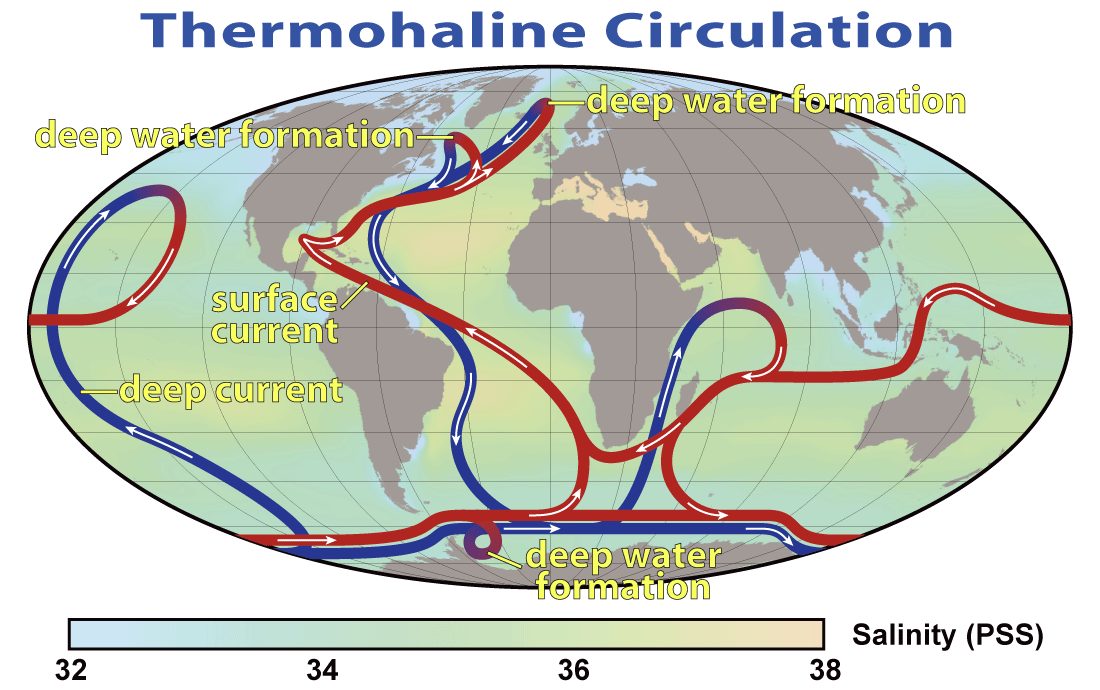
The Atlantic Meridional Overturning Circulation, or AMOC, carries warm water from the tropics north toward the Arctic and helps keep Europe's winters mild, Reuters reported. A collapse could bring "ice age" winters to Europe, raise sea levels in North America and disrupt monsoons in Africa and Asia, New Scientist reported.
The study, led by Chuncheng Guo of the Danish Meteorological Institute, was published in the journal Science Advances, the outlets said. It used a single climate model that included melting of the Greenland ice sheet, New Scientist reported.
In the model, the current slowed to about 6 million cubic meters of water per second from around 17 million at about 7 degrees Celsius of warming, Reuters reported. It did not shut down. "In our model, we do not see a tipping point leading to a collapse," Guo said, according to Reuters. Reuters noted that a 7-degree rise is far beyond current warming projections.
If the world cooled, the current would start to regain strength within decades, New Scientist reported. Full recovery could take several centuries, Guo said, according to Reuters. The cooling would also require enormous carbon removal. "That is not something we can achieve with today's technology," Guo told New Scientist. Reuters reported that the study found the Greenland ice sheet could not be restored once it had melted.
Outside scientists urged caution. Willem Huiskamp of the Potsdam Institute for Climate Impact Research, who was not involved in the study, doubted the real current is as stable as some models suggest, Reuters reported. René van Westen of Utrecht University told New Scientist that restarting a collapsed AMOC could expose Europe to faster warming after a period of sharp cooling.
New Scientist said one model might overestimate the current's stability. Researchers in Germany are rerunning the same experiment with 10 different climate models, the magazine reported.
"Instead of relying on the global cooling to happen, it's a much, much safer strategy to not have warming in the first place," Guo said, according to Reuters.
What we know: In one climate model, the AMOC weakened with warming but did not collapse, and it began to recover once temperatures fell.
What we don't: Whether the real current would behave the same way; tests with other models are still underway.
Where outlets agree New Scientist and Reuters both report that the study's single climate model showed the AMOC weakening with warming and starting to recover if the climate cools.
Where they differ The outlets cited here report the same key facts so far.