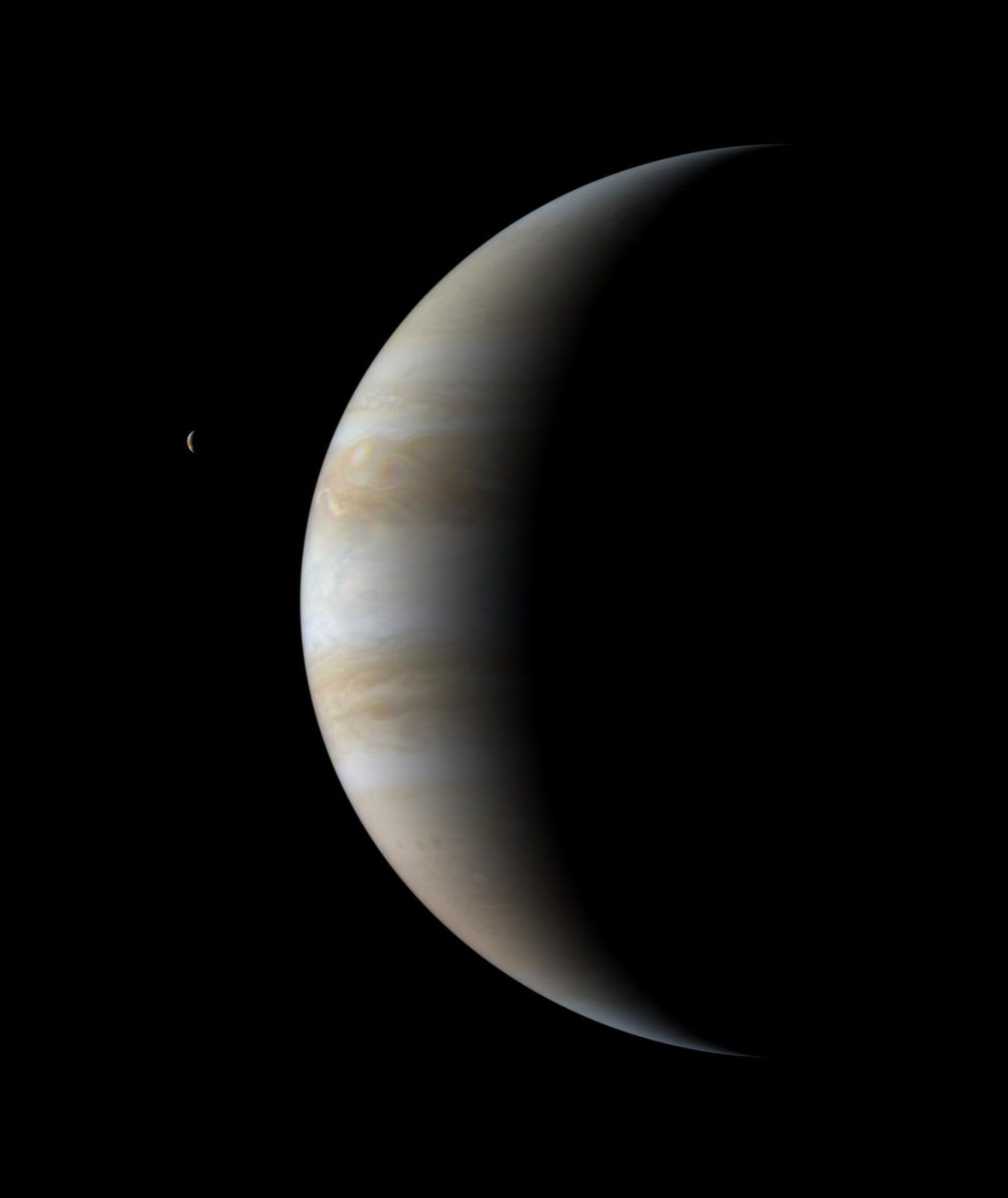
Simulations hint the giant planets could crash after the sun dies
Jupiter, Saturn, Uranus and Neptune could be thrown into chaos and even collide after the sun becomes a red giant, according to Live Science. The outlet reports on a new study based on 672 computer simulations. Scientists had long thought the outer planets would stay stable for hundreds of billions of years.
Jupiter, Saturn, Uranus and Neptune could be thrown into chaos and even collide after the sun becomes a red giant, according to Live Science. The study was published in The Astrophysical Journal Letters, the outlet reports.
In about 5 billion years, the sun will swell into a red giant after burning through the hydrogen in its core, then collapse into a white dwarf, Live Science reports. Scientists had long thought the four outer planets would come through that phase mostly unharmed, the outlet reports.
The new work assumes the dying sun throws off mass in large blobs rather than smoothly, Live Science reports. Each blob gives the sun a small push, and many pushes could add up to a big kick that upsets the planets' orbits, the outlet reports. "They're kind of like coronal mass ejections, except much larger," said Jim Fuller of Caltech, a co-author.
Caltech planetary scientist Konstantin Batygin led the study, which ran 672 simulations, Live Science reports. When the sun lost mass in the heaviest blobs, the planets crashed into each other in 96% of the runs, the outlet reports. In other cases they swapped places, took on oval orbits or were thrown out of the solar system.
The findings suggest systems like our outer solar system may be rarer around white dwarf stars than thought, Live Science reports, citing Nathan Kaib of the University of Oklahoma, who was not involved.
What we know: Simulations suggest the outer planets could collide after the sun dies if it sheds mass in blobs.
What we don't: Whether the sun will actually lose mass that way. Only Live Science has reported this so far. NewsHabit hasn't seen independent confirmation.
Where outlets agree Live Science reports a new study found the giant planets could collide after the sun becomes a red giant.
Where they differ Live Science's account is based on the published study. No other party has disputed it so far.