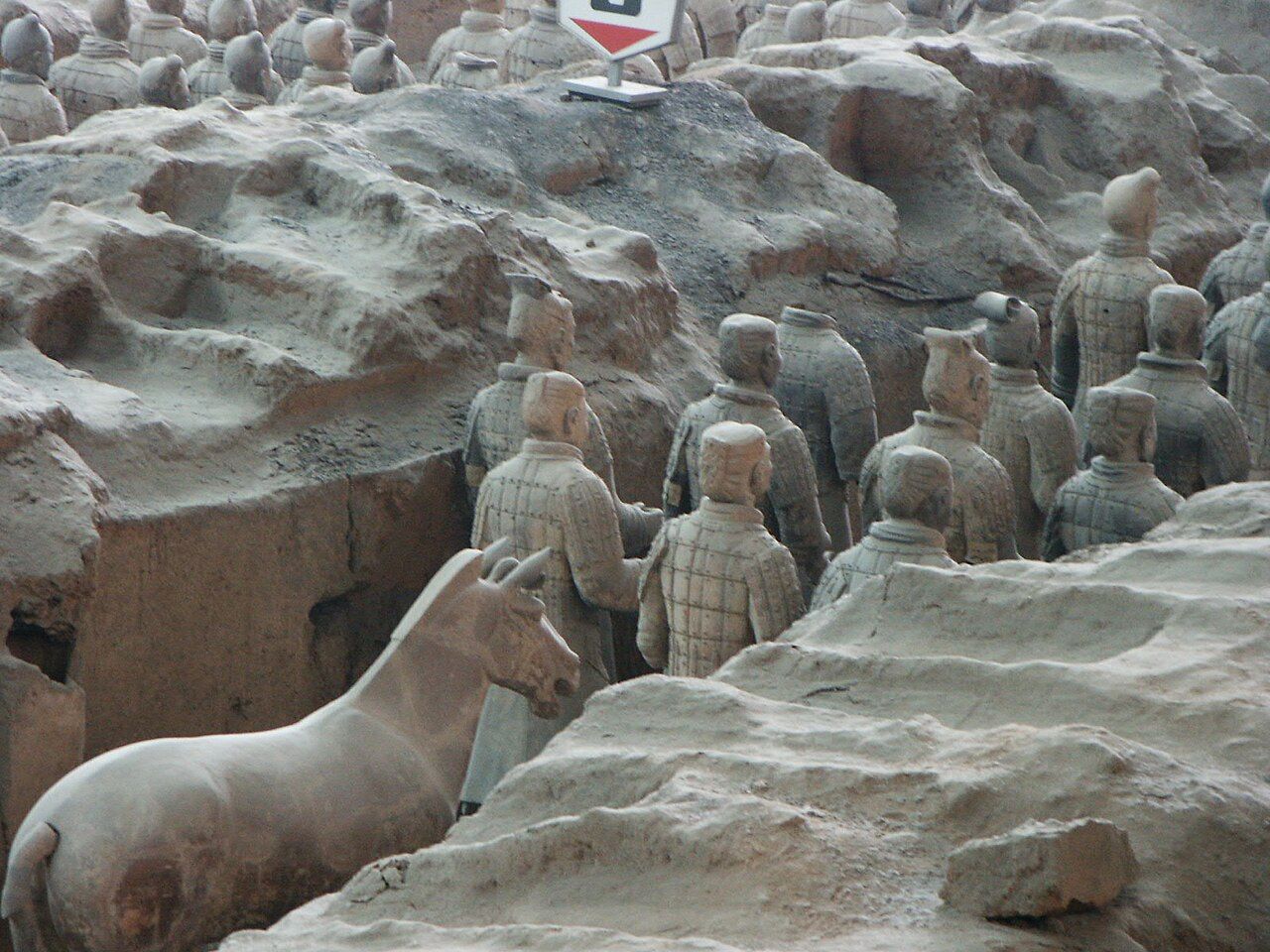
Fingerprints suggest women and children helped build Terracotta Army
Fingerprints on China's 2,200-year-old Terracotta Army suggest women and children worked alongside men to make it, ScienceAlert and Arkeonews reported. Researchers studied 79 prints on 36 clay warriors from one part of a pit. They said the results show who left prints, not how many workers there were.
Fingerprints left in the clay of China's Terracotta Army suggest that women and children helped make the famous statues, according to ScienceAlert and Arkeonews. Scholars have long assumed the work was done by adult men, the outlets reported.
The army was made about 2,200 years ago to guard the tomb of Qin Shi Huang, China's first emperor. Farmers found it in 1974 near Xi'an, ScienceAlert and Arkeonews reported.
The researchers studied 79 fingerprints on 36 warriors from one unit in Pit 1, Arkeonews reported. ScienceAlert said the prints came from a single pit. Most prints were left on heads and arms, where workers gripped the clay, ScienceAlert reported.
The team measured the spacing between the ridges of each print, the outlets reported. That spacing changes as people grow, and adult men tend to have wider ridges than women, ScienceAlert said. A statistical model then estimated the mix of people behind the prints.
About 45% of the prints likely came from adult men, the model found, according to ScienceAlert and Arkeonews. About 32.7% came from adult women. About 22.3% came from children under 15.
The researchers warned that these shares reflect fingerprints, not the number of workers, the outlets reported. Less skilled workers may have left more prints than experts, ScienceAlert said. The study also used modern European reference data, which adds doubt, ScienceAlert reported.
Records from the Qin era show that women and children worked in state workshops making lacquerware, the outlets reported. Young apprentices may have done simple tasks such as adding armor details, the researchers suggested, according to ScienceAlert.
The study was led by Xiaoxi Li of the Emperor Qinshihuang's Mausoleum Site Museum, ScienceAlert and Arkeonews reported. It was published in the Journal of Cultural Heritage, Arkeonews said. Future work could add more fingerprints to build a larger sample, ScienceAlert said.
What we know: Fingerprints on 36 warriors point to a mix of men, women and children.
What we don't: How many workers of each kind built the full army.
Where outlets agree ScienceAlert and Arkeonews report that a study of 79 fingerprints on 36 Terracotta Army warriors estimated that about 45% came from adult men, 32.7% from adult women and 22.3% from children under 15.
Where they differ Arkeonews places the 36 warriors in Unit T23 of Pit 1, while ScienceAlert says only that they came from one section of the site.