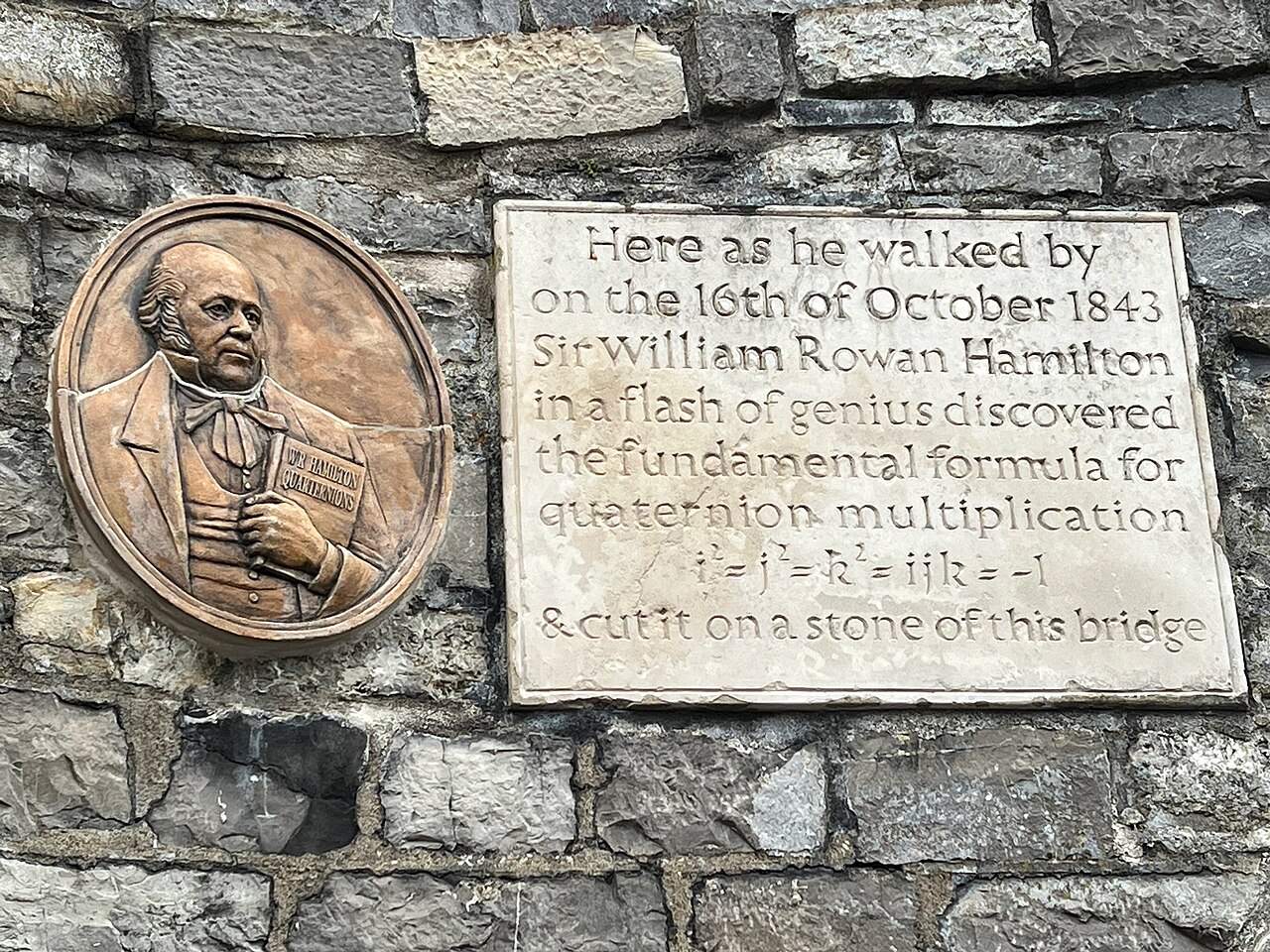
On this day, 1843: Hamilton carves quaternion formula into Dublin bridge
On Oct. 16, 1843, Irish mathematician William Rowan Hamilton came up with a new kind of number, called quaternions, on a walk in Dublin. He carved the key formula into Broom Bridge, according to RTÉ and Trinity College Dublin. Today the math helps computers turn 3D objects in games and films.
On Oct. 16, 1843, Irish mathematician William Rowan Hamilton hit on quaternions, a new number system, while walking along Dublin's Royal Canal, and carved the key formula into a stone of Broom Bridge, according to RTÉ and Trinity College Dublin's School of Mathematics.
Hamilton was walking with his wife, Helen, from their home at Dunsink Observatory to a meeting at the Royal Irish Academy, mathematicians Colm Mulcahy of Spelman College and Michel Destrade of NUI Galway wrote for RTÉ Brainstorm. Trinity's history page gives the formula he carved as i² = j² = k² = ijk = -1.
Quaternions are a four-dimensional number system with an unusual rule, the RTÉ authors wrote: the order in which two of them are multiplied makes a big difference. Ordinary numbers do not work that way, since two times three is the same as three times two. Hamilton had first tried to extend complex numbers into three dimensions and failed, they wrote, but adding a fourth dimension worked.
Hamilton presented his discovery to the Royal Irish Academy on Nov. 13, 1843, according to Trinity's page. His "Lectures on Quaternions" came out in 1853 and runs 736 pages, the page says.
No trace of the original carving remains, the RTÉ authors wrote. A plaque has marked the spot since 1958, unveiled by then-Taoiseach Éamon de Valera. An annual Hamilton Walk retraces his route and ends at the bridge, they wrote.
Many of Hamilton's other uses for quaternions were later replaced by vector calculus, but quaternions have come back in the past half-century, the authors wrote. Unit quaternions are an efficient way to handle 3D rotations in computer animation, and the 1996 video game "Tomb Raider" used them for smooth rotations, they wrote.
"We use them in our Inverse Kinematics and Skeleton code, for example," Pixar software engineer George ElKoura said, according to the RTÉ piece. "We also use them in camera manipulations."
What we know: Hamilton found quaternions on Oct. 16, 1843, carved the formula on Broom Bridge and presented the work in November.
What we don't: Exactly what the original carving looked like, since no trace of it remains.
Where outlets agree RTÉ and Trinity College Dublin both date Hamilton's discovery of quaternions to Oct. 16, 1843, on a walk along the Royal Canal that ended with the formula carved on Broom Bridge.
Where they differ The outlets cited here report the same key facts so far.