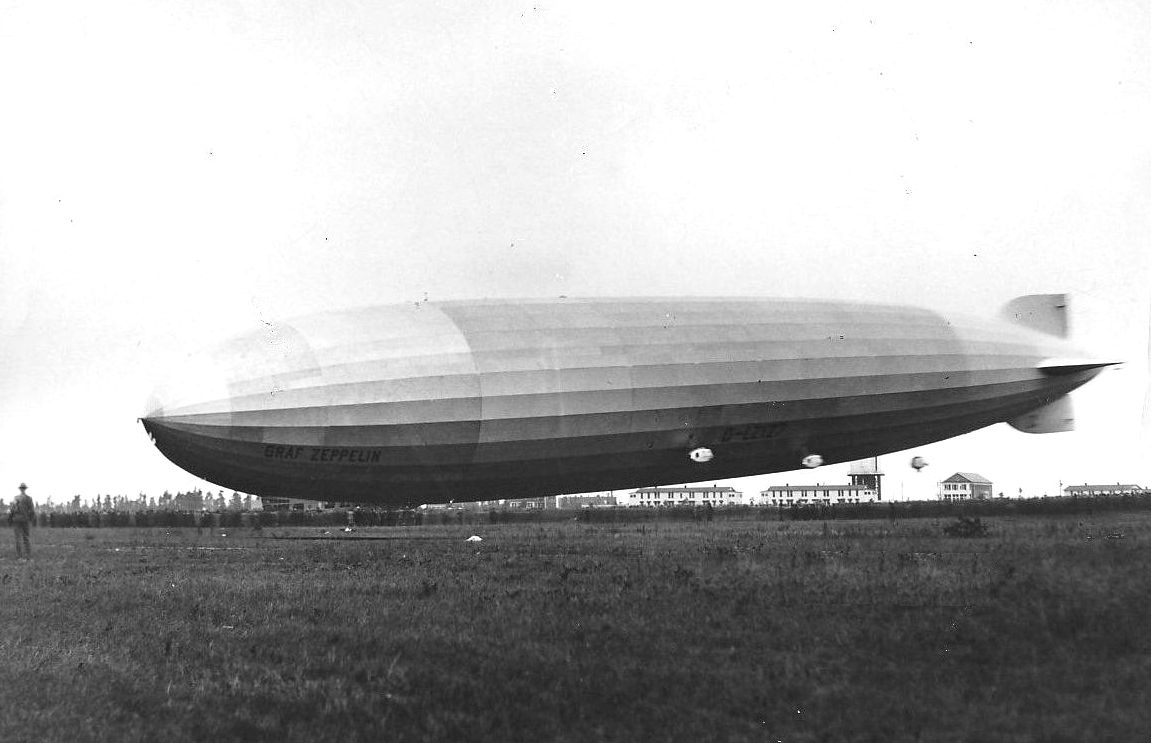
On this day, 1928: Graf Zeppelin reaches New Jersey from Germany
On Oct. 15, 1928, the German airship Graf Zeppelin landed in Lakehurst, New Jersey, after flying across the Atlantic. The Guardian reported that the trip took 111 hours and carried 20 passengers. TIME magazine called it the first air liner to cross the Atlantic.
The German airship Graf Zeppelin landed at Lakehurst, New Jersey, on Oct. 15, 1928, after crossing the Atlantic from Germany, The Guardian and TIME reported. TIME called it "the first trans-Atlantic air liner."
The ship carried 20 passengers and a crew of 40, The Guardian reported at the time. It set a record of 111 hours of nonstop flight over a route of about 6,300 miles, the paper reported. TIME also put the trip at 111 hours but gave the distance as 6,000 miles.
The airship left Friedrichshafen in Germany on the morning of Oct. 11, both outlets reported. It was commanded by Hugo Eckener, TIME reported, and its passengers included U.S. Navy Cmdr. Charles Rosendahl and Lady Grace Drummond Hay.
The crossing nearly ended in disaster. A gale tore the port stabilizer, and the ship had to slow down while repairs were made, TIME reported. Airships.net says that on the morning of Oct. 13 the ship pitched up sharply in a squall, and Eckener sent four men, including his son Knut, out onto the fin to repair it in flight.
The Guardian reported that crowds could see the damage as the ship arrived. One fin had a hole of about 900 square feet, the paper reported. Near the end of the trip, food was being rationed, TIME reported.
The ship passed over Washington, where President Calvin Coolidge watched from the White House garden, The Guardian reported. It then flew over New York, passing the Statue of Liberty and the length of Manhattan. "It is safe to say that few of the city's six millions missed the spectacle," the paper wrote.
It was twilight when the ship reached Lakehurst, where a landing crew of 450 pulled it down and into a hangar, TIME reported.
Airships had crossed the Atlantic before, starting with the British R34 in 1919, The Guardian noted.
The Graf Zeppelin went on to fly more than a million miles on 590 flights over nine years, according to Airships.net.
What we know: The Graf Zeppelin reached Lakehurst on Oct. 15, 1928, after about 111 hours in the air.
What we don't: How close the fin damage came to forcing the ship down at sea.
Where outlets agree The Guardian and TIME both say the airship flew about 111 hours from Friedrichshafen and passed over Washington before reaching Lakehurst.
Where they differ The Guardian put the route at about 6,300 miles, while TIME gave it as 6,000 miles.