Webb spots dusty clues to planet-size crashes around young stars
NASA's James Webb Space Telescope studied 21 rare dusty disks around young stars that show signs of huge collisions. Some look like crashes between Mars-size worlds, like the one thought to have formed our Moon. The study, led by Kate Su, appears in The Astrophysical Journal.
Billions of years ago, a Mars-size object called Theia likely slammed into the young Earth. Some of the debris came together to form the Moon. Now NASA's James Webb Space Telescope is finding signs of similar crashes around other young stars.
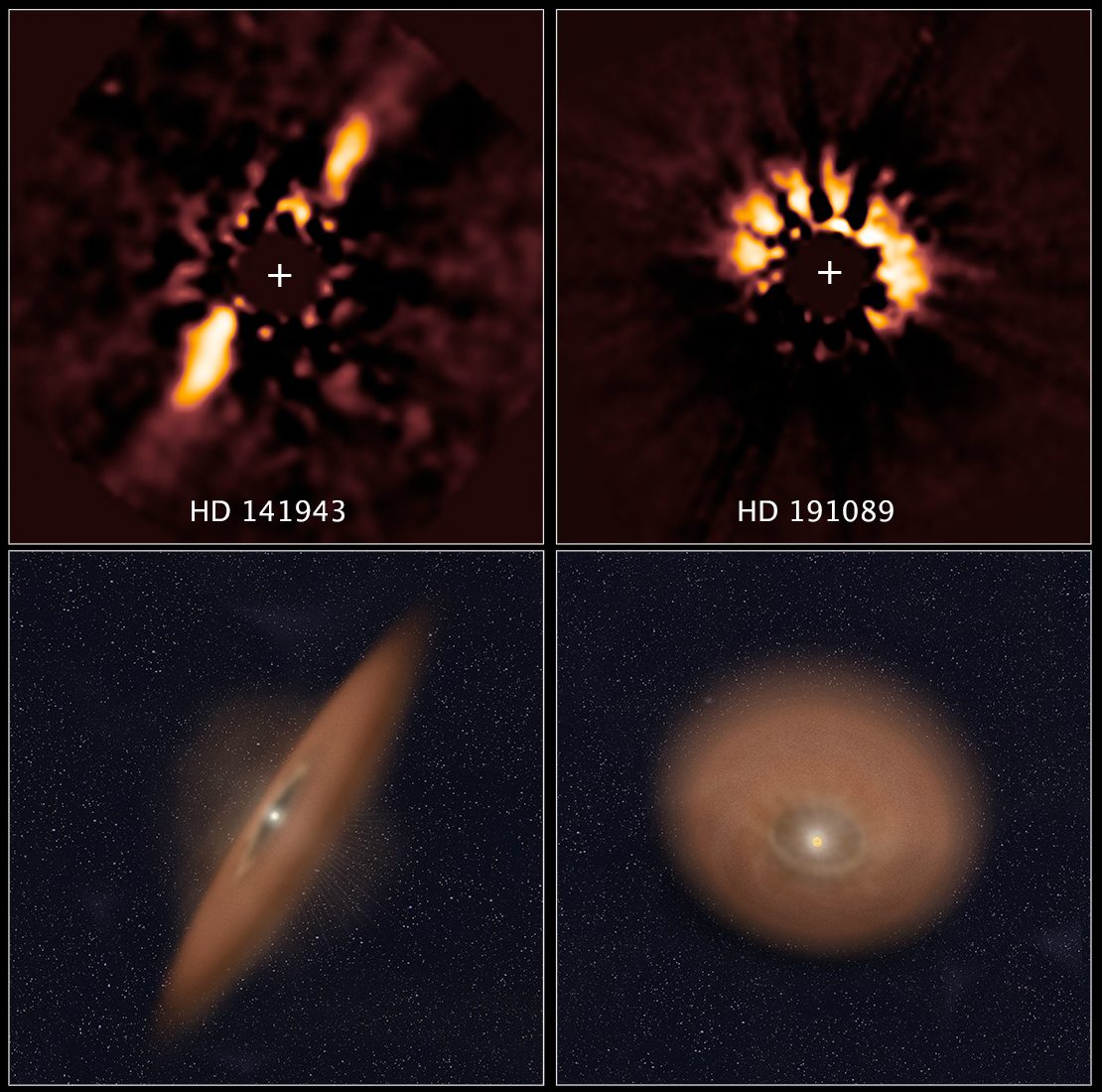
A team led by Kate Su of the Space Science Institute in Boulder, Colorado, studied a rare kind of star system called an extreme debris disk. These disks have unusually large amounts of warm dust close to their stars. That is about where rocky planets orbit in our own solar system. The results were published in The Astrophysical Journal, NASA said.
Theory says these disks should be common. But only about 1% of young stars show them. Our solar system may once have gone through this stage.
The team gathered 21 of these disks, the largest set yet. Five came from old data from NASA's retired Spitzer Space Telescope. Sixteen came from Webb, including 12 never studied before.
"This is the first time we have gathered enough systems to truly understand this subclass that we call extreme debris disks," Su said.
The team found that all of these disks share three traits. They have smaller dust grains than other disks. They hold a lot of warm dust. And their brightness changes in uneven ways. Webb's view in mid-infrared light revealed these features.
The makeup of the dust tells a story. Disks rich in silica point to high-energy crashes between bodies about the size of Mars, according to the NASA and ESA research summaries. Disks with less silica point to gentler, often glancing blows between bodies about the size of our Moon.
The work helps scientists understand how rocky planets like Earth form and change. It may also shed light on the giant impact that made the Moon. NASA noted that its Artemis program is now returning people to the Moon.
The European Space Agency, a Webb partner, also released the findings.
What we know: Webb confirmed shared traits in 21 rare disks tied to violent collisions.
What we don't: How common such crashes are in young planetary systems.
Where outlets agree NASA and ESA both report that Su's team studied 21 extreme debris disks, five from Spitzer and 16 from Webb.
Where they differ Theory predicts extreme debris disks should be common, yet only about 1% of young stars show them, and scientists don't yet know why.