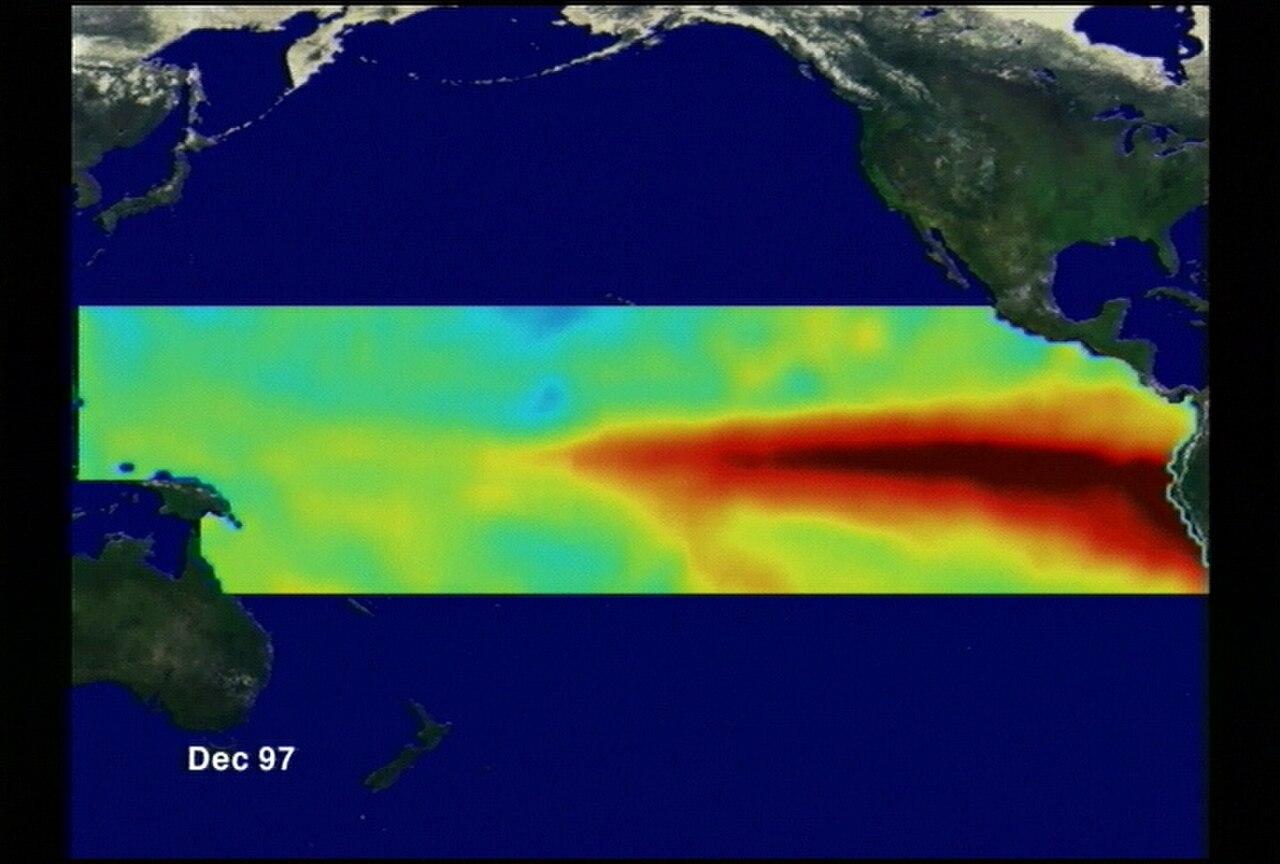
El Niño breaks records weeks before expected peak
NOAA and BBC Weather report the developing El Niño has already set daily sea-surface temperature anomaly records in the core Niño region, with scientists calling the event mind-blowing. Peak intensity is still expected later, amplifying global heat, drought, flood, and storm risks.
The current El Niño has already broken daily sea-surface temperature anomaly records in a key central-eastern Pacific monitoring region weeks before its expected peak, BBC Weather and NOAA Climate Prediction Center products indicate, with some researchers branding the event “mind-blowing” and “Godzilla-level.”
On September 19, daily anomalies reached about 3.05°C above average, exceeding the prior 3.02°C mark from the very strong 2015–16 El Niño. Longer-term indices have not all set records yet, but forecasters expect further warming into late 2026. El Niño arises when Pacific trade winds weaken and warm water spreads eastward, releasing heat into the atmosphere and rearranging rainfall belts—typically suppressing Atlantic hurricanes while boosting eastern Pacific cyclone potential, as Hurricane Polo’s explosive intensification illustrates.
Impacts cascade through health, food, and disaster systems: Climate Impact Lab’s companion mortality study, World Food Programme hunger warnings, and regional drought/flood outlooks all cite the same underlying ocean state. CPC seasonal outlooks favor wetter odds for parts of the southern United States this winter alongside broadly warmer conditions. Accounts agree the event is historically strong early; they debate how much anthropogenic warming is amplifying its impacts versus the natural oscillation alone.
NewsHabit’s Science card focuses on the NOAA/BBC temperature-record facts and storm linkage, pairing with the Health mortality projection rather than duplicating death counts here. Officials and independent outlets continue updating confirmed details as they become available. Officials and independent outlets continue updating confirmed details as they become available. Officials and independent outlets continue updating confirmed details as they become available. Officials and independent outlets continue updating confirmed details as they become available.
Where outlets agree NOAA-linked and BBC reporting agree core Niño region daily SST anomalies have set records ahead of the expected peak.
Where they differ Scientists differ on how to partition natural El Niño variability from climate-change amplification of impacts.