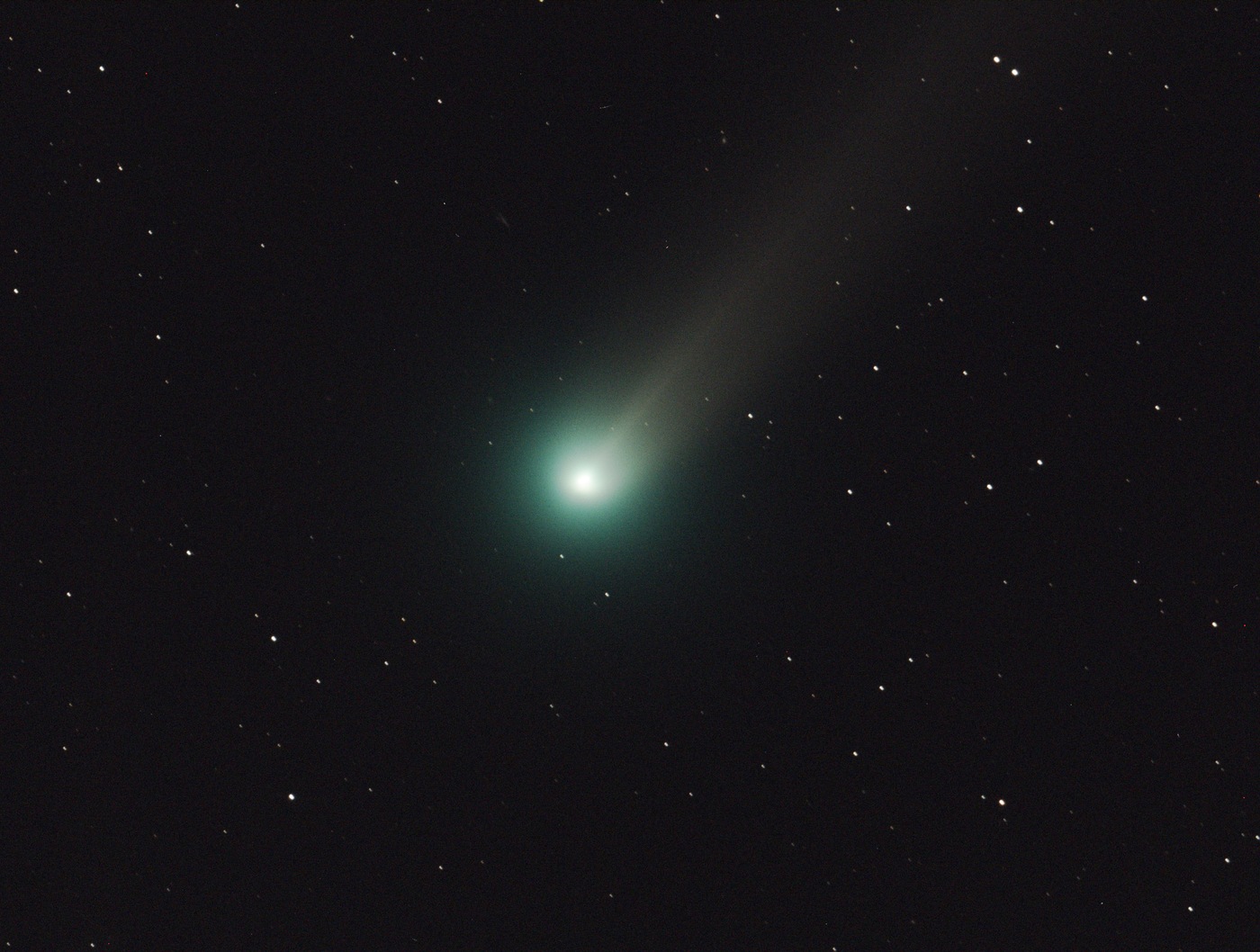
Escaping gases tore open a comet, making it far brighter
According to Space.com, gas bursting out of comet 220P/McNaught ripped open its crust this year and made it thousands of times brighter. The comet blasted billions of pounds of dust into space. A new study in the Monthly Notices of the Royal Astronomical Society describes the outbursts.
According to Space.com, gas bursting out of comet 220P/McNaught ripped open its crust this year and made it thousands of times brighter. The comet blasted billions of pounds of dust into space. A new study in the Monthly Notices of the Royal Astronomical Society describes the outbursts.
Comets hold ices of water, carbon dioxide and other gases under a dusty crust, Space.com reports. Heat from the sun can turn those ices into gas fast. The pressure of the escaping gas can rip the surface apart.
"We have concluded that the comet detached localized parts of its crust, creating a dust-rich envelope that increased [the comet's brightness by] 250 times in half a day," said Josep M. Trigo-Rodríguez of the Institute of Space Studies of Catalonia, according to Space.com.
The comet was found in 2004 and circles the sun every five and a half years, Space.com reports. It is normally too faint for most amateur telescopes.
Its first outburst came early this summer and made it bright enough for small telescopes, Space.com says. A second outburst began in late July and made it brighter still by early August. The dust spread out from the comet at about 390 meters per second.
Scientists hope outbursts like these reveal how strong comets are, in case one is ever found heading for Earth. "Some comets seem determined to demonstrate that they are fragile enough," Trigo-Rodríguez said, according to Space.com.
The comet is now fading as it heads away from the sun. It will return in late 2031, Space.com reports.
Only Space.com has reported this so far; NewsHabit hasn't seen independent confirmation.
What we know: Escaping gas tore open the crust of comet 220P/McNaught and made it far brighter, Space.com reports. What we don't know: Why the crust broke open when it did, and whether a second outlet will confirm the report. None has so far.
Where outlets agree Space.com reports that escaping gases tore open the crust of comet 220P/McNaught, making it thousands of times brighter.
Where they differ The Space.com report does not include comment from scientists outside the study team.