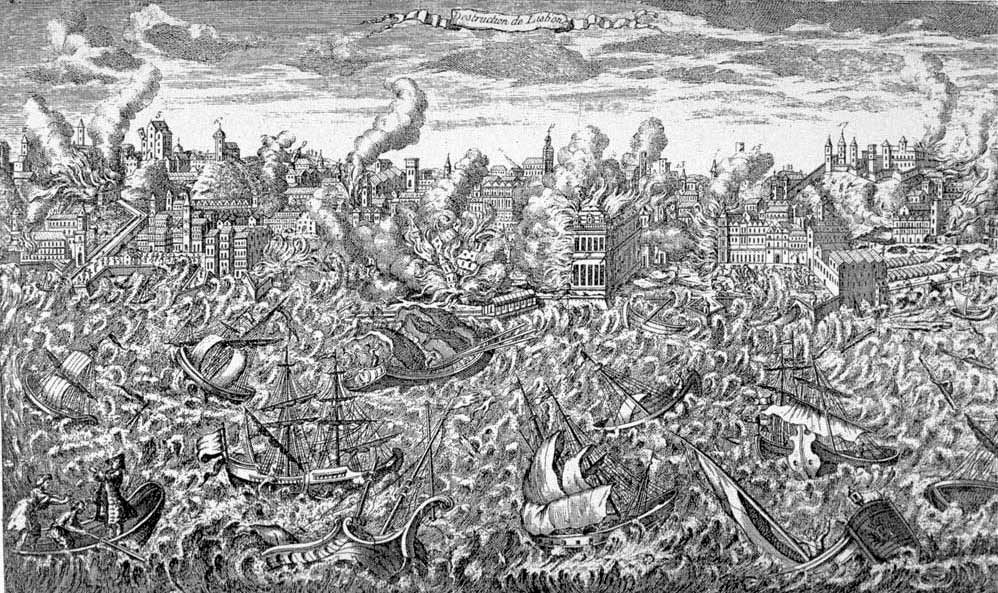
On this day in 1755, an earthquake destroyed much of Lisbon
On November 1, 1755, a huge earthquake struck Lisbon, Portugal, on All Saints Day. A tsunami and fires followed, and much of the city was destroyed. Tens of thousands of people died, though History.com and Scientific American give different estimates.
On November 1, 1755, a powerful earthquake struck Lisbon, Portugal, History.com and Scientific American reported. It was All Saints Day, and many people were in church. Many died when the churches fell, the two outlets reported.
Three strong tremors hit the city within about 10 minutes, the two outlets reported. History.com said the worst quake is thought to have been about magnitude 8.0, though no equipment existed then to measure it. The shaking was felt as far away as Morocco, the site said.
A tsunami followed. History.com put the wave at about 20 feet high. A Scientific American blog post said the waves reached 12 meters and that waves of about 4 meters reached the Caribbean.
Fires then spread across the city. Scientific American said they burned for five days and that three quarters of Lisbon was left in ruins. The royal palace was destroyed, History.com said.
The death toll is not known for sure. History.com said estimates range from 10,000 to 50,000. Scientific American put the toll at 30,000 to 60,000.
Religious leaders said the quake was a punishment from God, the two outlets reported. The French writer Voltaire mocked that idea in his novel Candide, History.com said. Scientific American said the disaster led many people in Europe to see earthquakes as natural events for the first time.
The Marquis of Pombal led the work to rebuild the city, the two outlets reported. History.com said narrow, twisting streets were replaced with broad avenues. The rebuilding also included one of the first uses of buildings made from parts built ahead of time, the site said.
What we know: The earthquake, tsunami and fires destroyed much of Lisbon in 1755.
What we don't: Exactly how many people died.
Where outlets agree History.com and Scientific American agree the November 1, 1755, earthquake was followed by a tsunami and fires that destroyed much of Lisbon.
Where they differ History.com estimates 10,000 to 50,000 deaths and a 20-foot tsunami, while a Scientific American blog post cites 30,000 to 60,000 deaths and 12-meter waves.