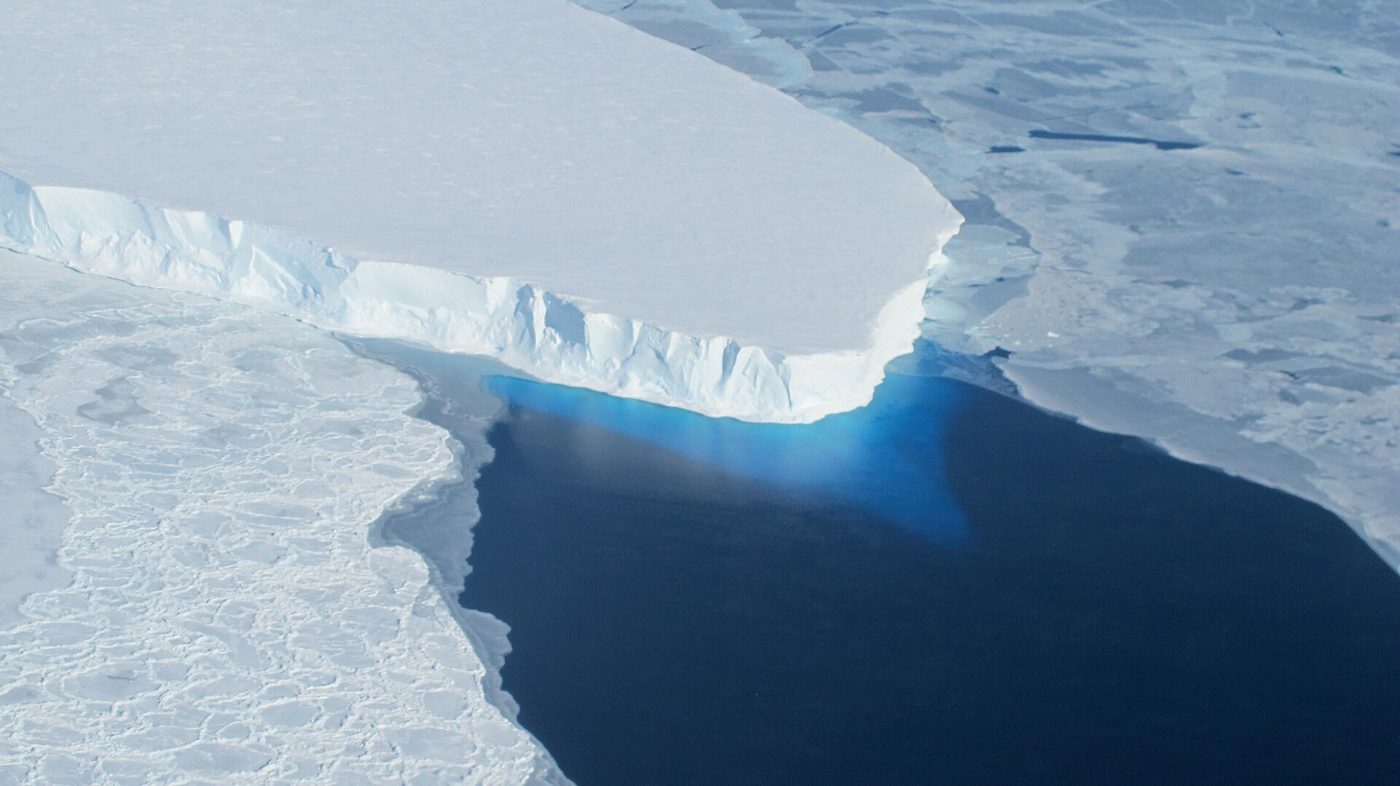
Thwaites glacier would keep losing ice even if oceans cooled
Antarctica's Thwaites glacier would keep losing ice for at least 150 years even if ocean melting stopped, according to New Scientist. Researchers turned off ocean melt in three computer models. The glacier still shrank, though more slowly, while its neighbor, Pine Island, grew again.
Antarctica's Thwaites glacier will keep losing ice for at least the next 150 years even if ocean melting stopped completely, according to New Scientist, which reported on a new study in Geophysical Research Letters.
Thwaites, often called the "doomsday glacier," is the world's widest glacier and is roughly the size of Great Britain, New Scientist reported. With the nearby Pine Island glacier, it is losing more ice than any other part of Antarctica, mainly because warmer ocean water melts it from below. If Thwaites collapses completely, it is expected to set off wider loss of the West Antarctic ice sheet and raise sea levels by about 5 meters, or about 16 feet.
Rosie Williams of the British Antarctic Survey and her colleagues "did something quite wild," she said. In three computer models, they switched off all ocean-driven melting, which is impossible in real life, and ran them for 150 years.
The two glaciers went opposite ways. Pine Island advanced again and became more stable. Thwaites kept losing ice the whole time, though the rate slowed. "It's somewhat of a surprise that Thwaites glacier can't do that," Williams said.
The researchers think Thwaites is still feeling the effects of extreme El Niño conditions in the 1940s that kick-started its retreat. "They have a long memory," Williams said of glaciers. Ted Scambos of the University of Colorado Boulder said ocean heat from human-caused warming over about four decades pushed Thwaites into "an inherently unstable configuration."
Williams said this does not make cutting emissions pointless. The warmer the ocean, the faster the ice is lost, so "every fraction of a degree really matters," she said.
The study also offers some hope. "We haven't crossed the point of no return," said Mathieu Morlighem of Dartmouth College. In the best case, he said, Thwaites does not lead to a collapse of the West Antarctic ice sheet.
Williams is now studying what happens with realistic ocean temperatures, New Scientist reported.
What we know: In models with no ocean melting, Thwaites kept losing ice for 150 years.
What we don't: Only New Scientist has reported this so far; NewsHabit hasn't seen independent confirmation.
Where outlets agree New Scientist reports that Thwaites kept losing ice in three models with ocean melting turned off, citing a study in Geophysical Research Letters.
Where they differ No other researchers or outlets cited here have disputed the study's findings so far.