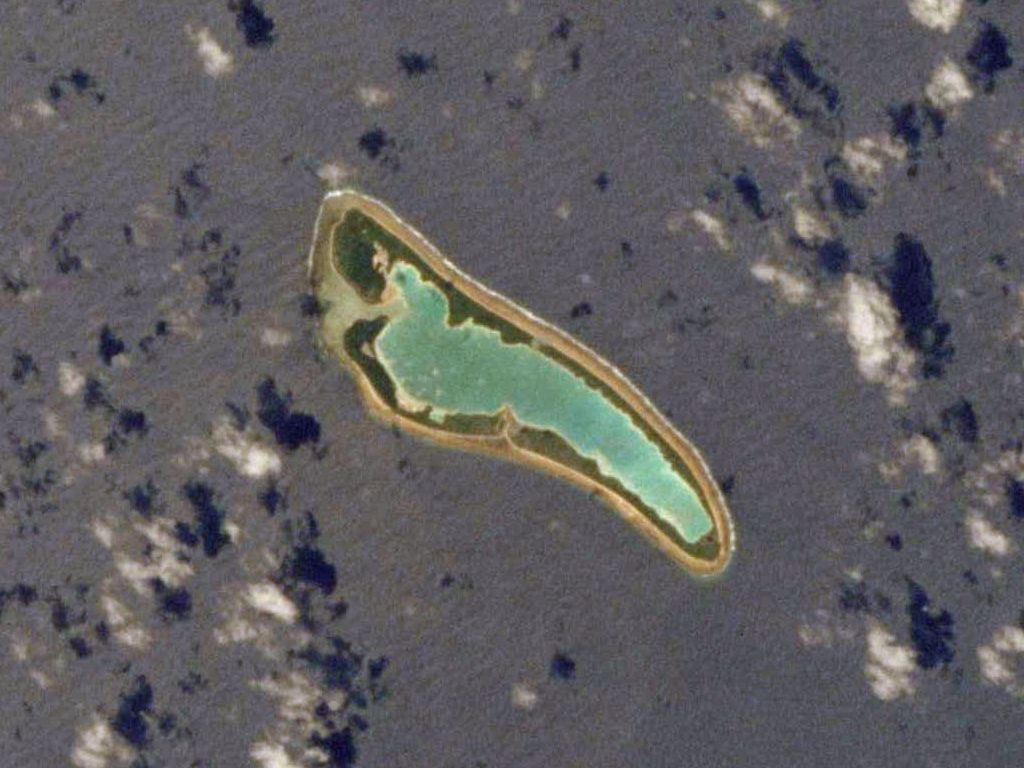
Earhart expedition finds trees, not her plane, on Nikumaroro
A team searching a Pacific atoll for Amelia Earhart's plane found that the object it hoped to find was likely a pile of large trees, The Guardian and CBS News reported. A shiny coat of coral sand had made it look like metal. The team left with no sign of the plane.
A team that sailed to the remote atoll of Nikumaroro to look for Amelia Earhart's plane has found that its main target was likely a pile of large trees, The Guardian and CBS News reported.
The object, known as the Taraia Object, was first seen in satellite images in 2020. It lay in the shallows near a sandy strip called the Taraia Peninsula. Purdue University, which helped lead the trip, said the object was "likely a collection of large trees deposited along the peninsula's sandspit," The Guardian and CBS News reported.
The object had seemed to shine like metal in photos. Purdue said that shine came from a "carbonate veneer." Other items the team found were "similarly coated with a shiny concretized amalgam of coral sand," Purdue said, as reported by The Guardian, CBS News and National Geographic.
The 17-person team was led by Steve Schultz of Purdue and Richard Pettigrew of the Archaeological Legacy Institute, CBS News reported. National Geographic also reported a 17-member team. "Unfortunately, we weren't able to find that smoking gun," Schultz said, The Guardian reported.
Pettigrew said the trip still did its job. "I think we accomplished our goal completely. The hypothesis has been tested, and the results are in," he said, National Geographic reported. National Geographic also reported that Pettigrew paid for the $900,000 trip with a line of credit from Purdue.
Earhart and her navigator, Fred Noonan, vanished in 1937 while trying to fly around the world. Nikumaroro is part of Kiribati, about halfway between Australia and Hawaii, The Guardian and CBS News reported. It lies about 400 miles from Howland Island, where the pair were headed, CBS News and National Geographic reported.
The team slept on its ship offshore, partly because of huge coconut crabs on the island, The Guardian and National Geographic reported. Purdue helped pay for Earhart's Lockheed Electra 10-E in the 1930s, The Guardian and National Geographic reported.
This is not the first false lead. In 2024, a sonar image that seemed to show a plane on the sea floor turned out to be a rock formation, CBS News and National Geographic reported.
What we know: The Taraia Object was most likely trees, and the team found no trace of Earhart's plane.
What we don't: What happened to Earhart and Noonan after they vanished in 1937.
Where outlets agree The Guardian, CBS News and National Geographic report that the object near the Taraia Peninsula was not Earhart's plane and that its shine came from a coat of coral sand.
Where they differ The outlets cited here report the same key facts so far.