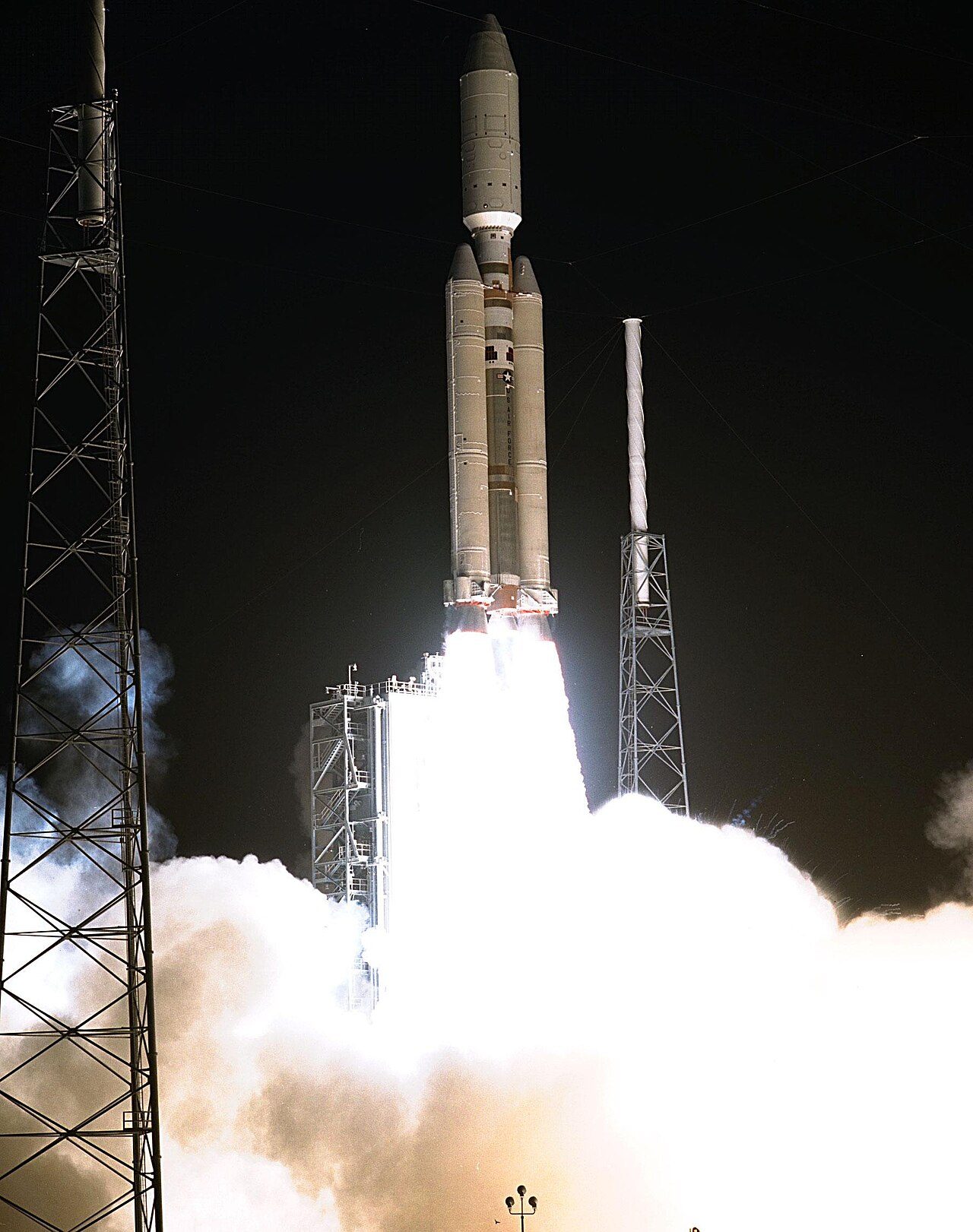
On this day, 1997: Cassini launches on its long trip to Saturn
On Oct. 15, 1997, the Cassini probe lifted off from Cape Canaveral on its way to Saturn, CNN and the Los Angeles Times reported. It carried Europe's Huygens probe for Saturn's moon Titan. The launch drew protests because the craft carried 72 pounds of plutonium.
On Oct. 15, 1997, the Cassini spacecraft lifted off from Cape Canaveral, Florida, on a Titan IV rocket bound for Saturn, CNN and the Los Angeles Times reported.
The launch came at 4:43 a.m. EDT, CNN reported. It followed a two-day delay caused by high winds, problems with ground test equipment and minor computer trouble.
Flames lit up the dark sky as the 6-ton spacecraft rose, the Los Angeles Times reported. "This is special," said physicist Hunter Waite, one of dozens of scientists at the launch.
Cassini was a joint project of NASA, the European Space Agency and the Italian Space Agency, the Los Angeles Times reported. It carried Europe's Huygens probe, which was to drop onto Titan, Saturn's largest moon.
The $3.4 billion mission was the largest and most expensive planetary probe in NASA's history, CNN reported. It was the first craft to visit Saturn since Voyager 2 in the early 1980s.
To reach Saturn, Cassini would swing past Venus twice and Earth once, using their gravity for a boost, the Los Angeles Times reported. The trip covered about 2.2 billion miles, both outlets reported.
The mission was also controversial. Cassini carried about 72 pounds of plutonium to make power, both outlets reported. Saturn is too far from the sun for solar panels, CNN reported.
Critics feared an accident could spread radioactive dust, the Los Angeles Times reported. Twenty-seven people were arrested for trespassing at the launch site on Oct. 4, the paper reported. A federal judge in Hawaii refused to block the launch, CNN reported.
NASA put the odds of Cassini falling back to Earth at 1 in a million, CNN reported. "I find that NASA bureaucrats in some sense are living in Fantasyland," physicist Michio Kaku told CNN.
The White House science office had found that "the important benefits of this scientific mission outweigh the potential risks," the Los Angeles Times reported.
Cassini reached Saturn in 2004, and the Huygens probe landed on Titan in January 2005, according to NASA. The mission ended in 2017.
What we know: Cassini launched Oct. 15, 1997, with about 72 pounds of plutonium on board and reached Saturn in 2004.
What we don't: When NASA will next send a spacecraft to orbit Saturn.
Where outlets agree CNN and the Los Angeles Times both report that the craft carried about 72 pounds of plutonium for power.
Where they differ The outlets cited here report the same key facts so far.