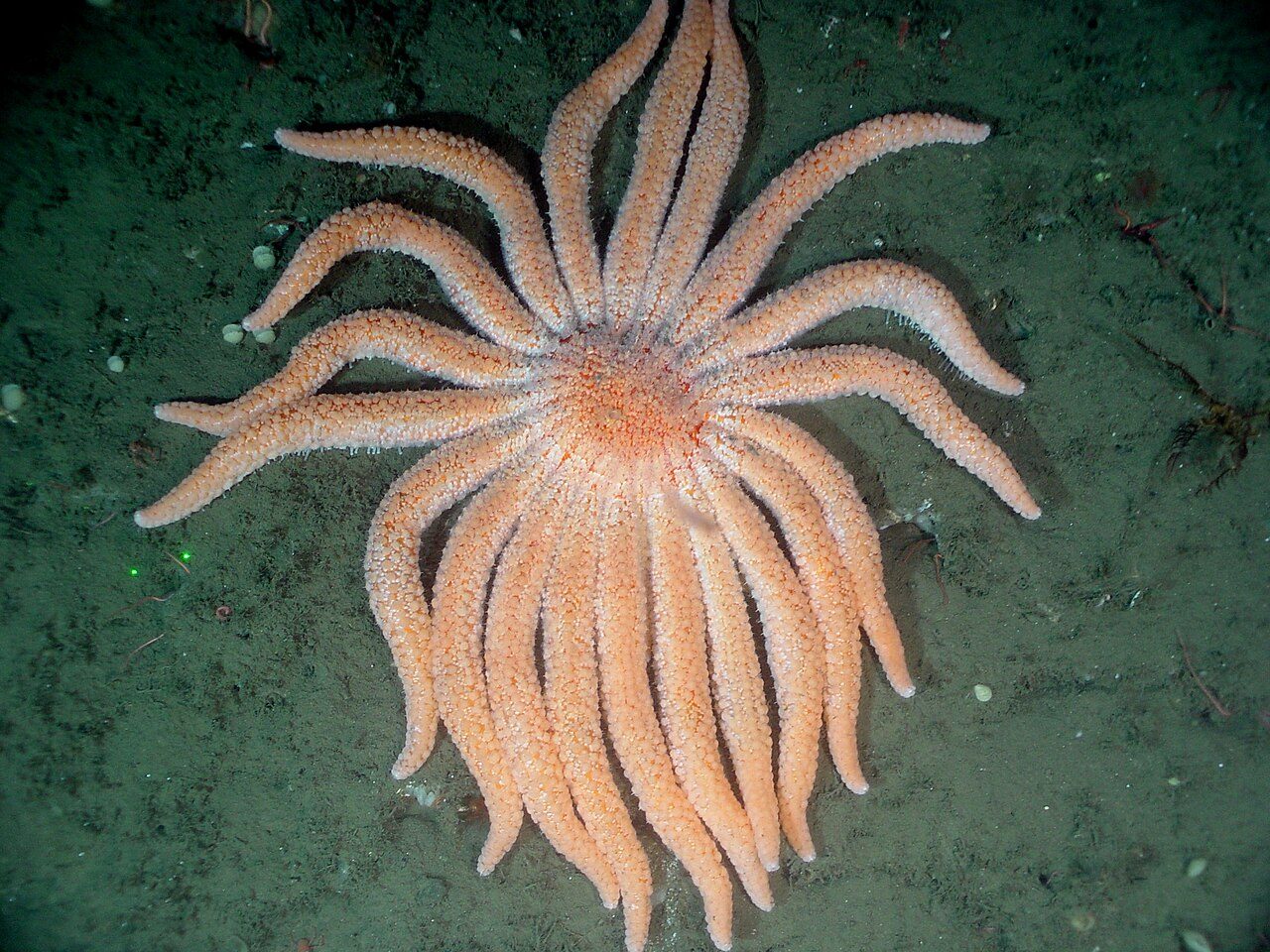
Lab-grown sunflower sea stars tested in Monterey Bay to protect kelp
Scientists have put lab-grown sunflower sea stars on the seafloor of Monterey Bay, California, for a test. The sea stars eat purple sea urchins, which have destroyed large areas of kelp forest. Researchers hope to release them for good in one to three years.
Scientists have released lab-grown sunflower sea stars onto the seafloor of Monterey Bay, California, in a test to see whether they can help bring back kelp forests, The Guardian, SFGATE and Monterey County Now reported.
The work is led by the Sunflower Star Laboratory, a nonprofit in Moss Landing, Monterey County Now said. Divers placed the sea stars in cages on the ocean floor with the doors left open, so the animals could roam, The Guardian reported.
Sunflower sea stars are large and can have up to 24 arms, The Guardian said. They eat purple sea urchins.
Starting around 2013, a disease called sea star wasting syndrome killed huge numbers of them along the West Coast, all three outlets reported. SFGATE said the species declined by roughly 92%. The Guardian said the disease wiped out more than 90% of the Pacific population. Researchers in 2025 identified the bacterium Vibrio pectenicida as the likely cause, SFGATE reported.
Without the sea stars, urchins multiplied and ate through kelp forests, leaving bare areas called urchin barrens, all three outlets said.
In the test, 16 sea stars were taken to Tankers Reef, Monterey County Now reported. The sea stars ate more than 3.5 urchins a day and grew over 50% in one month. One traveled more than 50 meters in two hours.
Their presence also scared urchins up to 5 meters away, a "landscape of fear," Monterey County Now said. Two of the 16 sea stars died, for 88% survival.
"Urchins and other grazers smell a sunflower star coming and they take off in fear," Reuven Bank, a co-founder of the lab, told The Guardian.
Permanent release is "going to happen in the next one to three years," Bank told Monterey County Now.
Kelp forests add more than $250 million a year to California's economy, SFGATE reported.
What we know: Lab-grown sea stars ate urchins and mostly survived in the Monterey Bay test.
What we don't: How they will do once released for good.
Where outlets agree The Guardian, SFGATE and Monterey County Now all report that the Sunflower Star Laboratory placed lab-grown sunflower stars in Monterey Bay to test whether they can curb urchins.
Where they differ The outlets cited here report the same key facts so far.