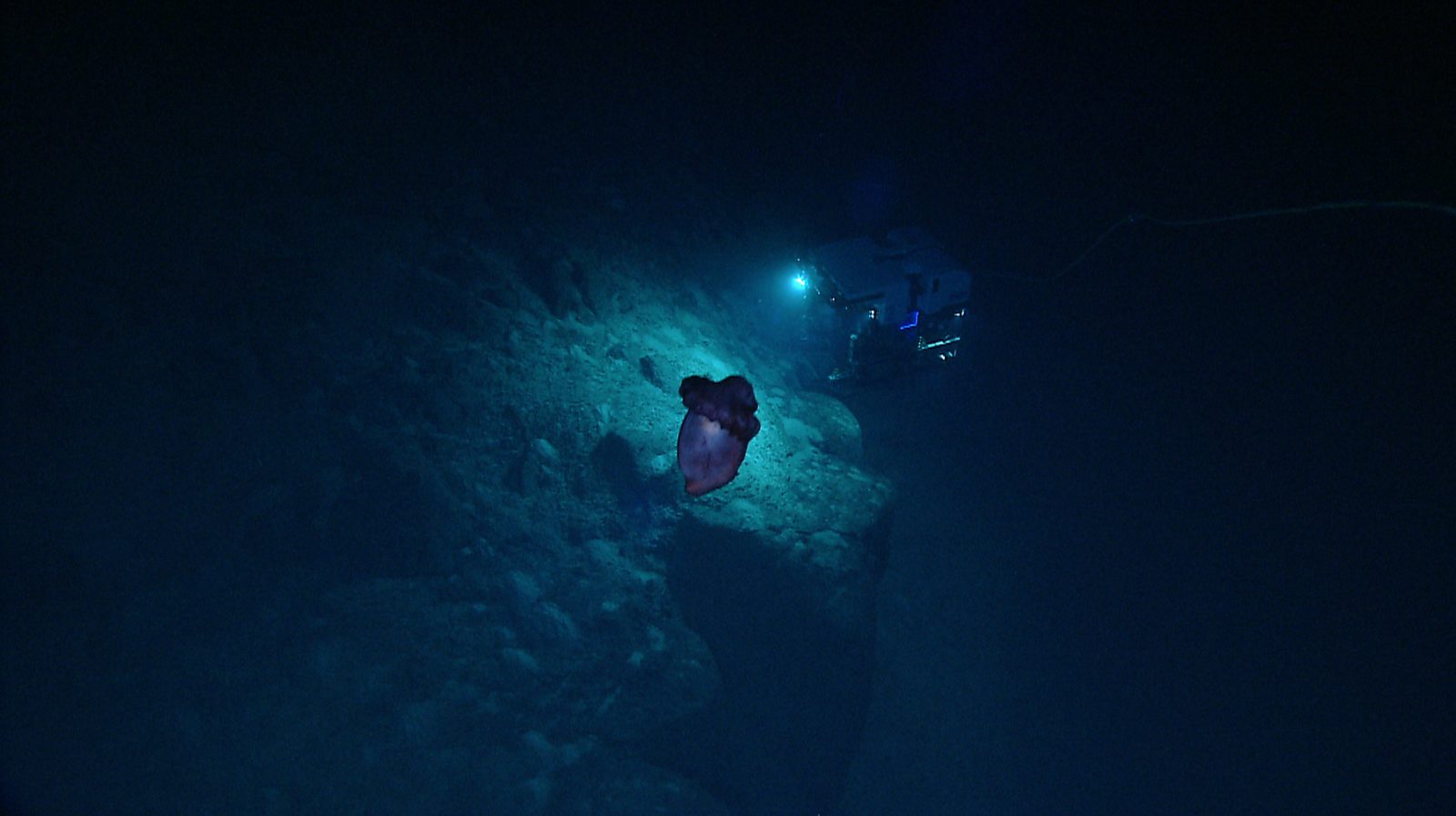
Horned 'Loki' sea cucumber among 57 new deep-sea species
Scientists say they found 57 new kinds of sea animals in a deep ocean canyon off Argentina. One is a sea cucumber with horn-like parts, nicknamed Loki. The team named them in a two-week workshop and shared the data openly.
A sea cucumber with two horn-like bumps has become the face of a big find in the South Atlantic Ocean. Scientists nicknamed it "Loki," after the Norse god often shown with horns. It is one of 57 marine species that are new to science.
The animals came from the Mar del Plata Submarine Canyon off Argentina. A research ship run by the Schmidt Ocean Institute, called Falkor (too), explored the canyon in August 2025 with an underwater robot named SuBastian. Popular Science reported the canyon is nearly twice as deep as the Grand Canyon. Loki was found about 2,577 meters, or 8,454 feet, down.
The area is busy with life because warm water from the north meets cold, rich water from near Antarctica there.
In July, 20 scientists and young researchers from Latin America and Europe met in Buenos Aires for two weeks to sort samples. The workshop was led by the Ocean Census group and the Schmidt Ocean Institute. They named 20 new copepods, which are tiny shrimp-like animals, plus 22 sea cucumbers and sea lilies, 14 corals and sea pens, and one tusk-shaped mollusk. They also found five whole new groups, called genera.
The team logged its finds on an open online database so other scientists can use them right away. Loki is one of as many as 10 new sea cucumber species from the trip, Oceanographic magazine reported.
"International cooperation in taxonomy is critical," said Daniel Lauretta, the Argentine scientist who led the expedition.
Why it matters: most of the deep sea has never been studied. Each new species helps scientists understand how ocean life works before it is harmed by fishing, mining or warming.
What we know: The workshop named 57 new species and five new genera from the canyon.
What we don't: How many more new species are still waiting in the unexamined samples.
Where outlets agree Popular Science and Oceanographic both report 57 new species and five new genera, led by the horned sea cucumber nicknamed Loki.
Where they differ Popular Science says the team examined only 10% of the expedition's samples, while Oceanographic says that 10% figure applied just to the copepod samples.