Starship Flight 14 hits first orbit, deploys 26 Starlinks, splashes down early
SpaceX's Starship reached orbit on Monday and deployed 26 Starlink V3 satellites. Controllers ended the flight early for safety. The ship splashed down north of Hawaii about three hours after liftoff.
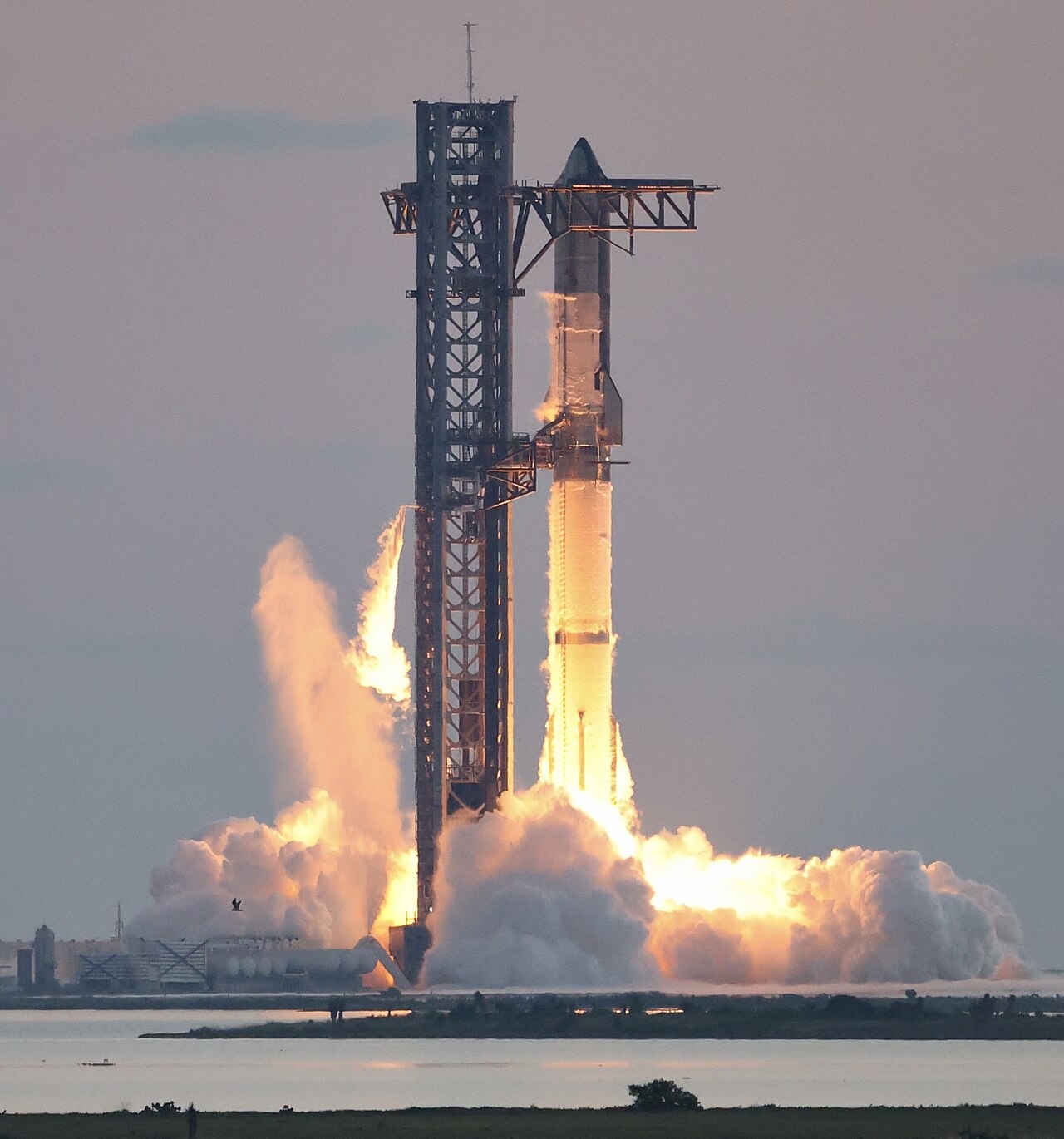
SpaceX's Starship flew to Earth orbit for the first time on Monday, September 28, then brought the test to a controlled early end with a Pacific splashdown north of Hawaii. Flight 14 lifted off from Starbase's Pad 2 in South Texas at about 8:49 a.m. Eastern (7:49 a.m. Central), inside a 75-minute window that had opened at 8:15 a.m. Eastern after SpaceX slipped the opening T-0.
Hot-staging separated Super Heavy Booster 21 from Ship 41 a little more than two and a half minutes into flight. The booster completed a landing burn and soft splashdown in the Gulf of Mexico. During Ship's ascent, one of six Raptor engines shut down early. SpaceX briefly told viewers the orbital attempt was off, then reversed course as controllers cleared a go. About 25 minutes after liftoff, Ship finished a single-engine insertion burn near 275 kilometers (about 170 miles) — the first sustained orbital trajectory for a Starship upper stage.
Ship then deployed all 26 Starlink Version 3 satellites through its Pez-style door over roughly half an hour starting near T+34 minutes. Three of those satellites carried cameras to scan heat-shield tiles. Associated Press, ABC News, and Space.com all report the full stack reached orbit for ongoing use — a first for Starship after thirteen prior full-stack flights that stayed suborbital. Elon Musk wrote that the first orbital flight was successful; later posts and space desks also said the 26 V3 birds were operating nominally.
The nominal plan was nearly 10 hours and about six Earth orbits, ending with a splashdown west of Chile. Controllers instead cut the flight short after the first scheduled health checkpoint. Space.com, updated at 12:15 p.m. Eastern, and ABC News, at about 12:12 p.m. Eastern, report Ship reentered and splashed down intact in the northern Pacific about three hours after liftoff — Space.com clocks splashdown at three hours and eight minutes — then tipped over and erupted on the waves. AP's Marcia Dunn package likewise says the flight ended early for safety, with splashdown north of Hawaii and a fiery tip-over. SpaceX called the truncated profile a success because both primary goals — first orbit and operational Starlink delivery — were met. Neither stage was planned for a tower catch on this flight.
Flight 14 is the third outing for the Block 3 stack and the longest Starship mission to date even after the early return. NASA is watching the program for Artemis lunar-lander work; Monday's data on orbital insertion, payload deploy, and heat-shield survival will feed the next flight's review. Replay and mission pages remain on spacex.com and SpaceX's X account; Space.com's Flight 14 success write-up carries the midday terminal timeline.
Where outlets agree Space.com, Associated Press, and ABC News agree Flight 14 reached orbit Monday, deployed all 26 Starlink V3 satellites, then ended early with a Pacific splashdown north of Hawaii about three hours after liftoff.
Where they differ Desks differ slightly on liftoff clocks (about 8:48–8:50 a.m. ET) and on how many orbits completed before the early deorbit. Space.com stresses the post-splashdown tip-over explosion; AP and ABC emphasize SpaceX's safety-driven early return versus the planned ~10-hour Chile splashdown.